
There is immense pressure on Biyani to go ahead with the RIL offer after FRL defaulted on its interest payments of Rs 100 crore on July 22.

Mukesh Ambani-owned RIL's JioMart is set to launch a slew of new products including financial services, electronics to airline tickets to take on the competition from upcoming rivals like the Tata Super app and other established players including PayTM, Amazon and Flipkart. This comes at a time when RIL's e-commerce revenues are set to grow by 35 per cent to $15 billion within four years and its core retail revenue is expected to grow at the same pace to $44 billion, as per a forecast by Goldman Sachs. "The Tata vs JioMart war will be the next big corporate battle to watch. "While Tata has an upper hand like in-house products and brands, RIL has the backing of global biggies like Google, Facebook and Microsoft," said head of a rating firm asking not to be quoted.

The department for promotion of industry and internal trade has rejected Walmart-backed Flipkart's proposal seeking approval for entry to the food retail sector, citing a regulatory issue, an official said on Monday. The government permits 100 per cent foreign direct investment in food retail for food produced and manufactured in India.

'We emphasise the importance of not basing investment decisions solely on electoral outcomes.' 'Instead, focusing on investing in high-quality businesses capable of prospering regardless of the political landscape is paramount.'

The company had set up its first store in New Delhi 12 years ago through the franchisee route, and it remains the only one in India from its stable so far.

'Just the amount of work which is there just to become more and more successful in banking. For this to happen you need to have leaders who understand technology.'

Our focus is on the best price, the best experience and the best quality.

Future Group and V-Mart have put in place systems to prevent panic buying at their neighbourhood grocery stores.

'Merchandise plays a key role in creating buzz about a specific party.'

Ramping up e-commerce operations and going beyond its current strongholds are key challenges for the grocery chain in its battle with Mukesh Ambani's retail behemoth.

For the third month running, investors opened over four million new demat accounts in February, showing growing household confidence in stock markets and their increased risk appetite. Over 13.12 million new demat accounts have been opened in the last three months, taking the total count close to the 150-million mark. Demat accounts are needed for trading and holding shares electronically.

The relaxation will be applicable for plastic bags above 50 microns for the next three months.
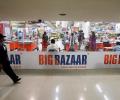
Kishore Biyani led-Future Group has filed a caveat before the Delhi high court requesting it to be heard if any plea is filed by e-commerce major Amazon over its Rs 24,713 crore deal with Mukesh Ambani-led RIL. Anticipating a move by Amazon, which had got an interim arbitration award in its favour, putting the announced deal on hold, the Future Group firm has moved the Delhi high court.

The Competition Commission of India has approved Tatas' proposal to acquire up to 64.3 per cent stake in BigBasket, a deal that will provide the diversified group a strong foothold in the fast-growing online grocery market.

Global sales made via mobile devices are expected to top $638 billion.

Credit Suisse said if the deal fructifies, then this will bring together the largest offline and online retailers in India.

From April 1, when we buy insurance for a car or take out a health cover, insurance companies can offer a product totally customised for us.

FSN E-Commerce Ventures (Nykaa) hosted its annual investor day recently. The responses were positive from analysts. Although some analysts pared FY25 and FY26 estimates, the bulk continued to issue 'buy' calls after the stock rose 2.5 per cent. The management expects the Beauty & Personal Care (BPC) business to grow at a 25 per cent compound annual growth rate (CAGR) during FY24-28.
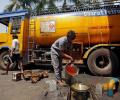
Investors shunned shares of oil marketing companies (OMCs) on Friday as they feared that the government's decision to cut retail prices of petrol and diesel could hurt the companies' profit margins in the near term. On Thursday, the government announced that OMCs will reduce pump prices of petrol and diesel after a record 22 months, making them cheaper by Rs 2 per litre in the national capital. The changes were effective from Friday.

The dealers operating in the space have jumped nearly three times over the past two years.

Severe skilled, unskilled shortage threatens to pull emergency brakes on India's industrial engine.

Global retail behemoths seem to have read the signals right.

With an epic battle of billionaires for supremacy in one of the world's most prolific markets and a pandemic-propelled surge in online shopping in the background, India's nearly trillion-dollar retail market is hoping to touch 85 per cent of the pre-COVID business in the first half of the New Year. In a year when the COVID-19 carnage ripped apart the retail business, circa 2020 will best go down for the unravelling of the war between Jeff Bezos, the world's wealthiest man, and richest Indian Mukesh Ambani for pre-eminence in the booming market that is estimated to reach $1.3 trillion by 2025. It all started with Ambani's Reliance Industries agreeing in August to buy assets of the nation's second-largest retailer for Rs 24,713 crore, just a year after Bezos' Amazon purchased an indirect stake in the indebted Future Retail.

'Sebi had no problem with derivatives until trading exploded after Covid.' 'But now, having built a dangerous road, from which different entities, mainly governments, are extracting a heavy toll, Sebi is concerned that people are driving on it in much greater numbers,' explains Debashis Basu.

In stock market parlance, "meme stock" was certainly the word of the year. Coined to mean those stocks that gain sudden popularity on the internet with resultant high prices, it was used to derisively describe the behaviour of retail traders globally who entered the market in huge numbers in the two Covid-19 years. A recent study, "Market Concentration and Retail Participation in India", by the National Stock Exchange economics team led by their chief economist Tirthankar Patnaik shows unlike these impressions, the retail investors, at least in India, have not performed inconsistently.
HDFC Bank has reshuffled the portfolios of its senior management team. This is the first major rejig after the amalgamation of HDFC Ltd on July 1. "The runway for our growth is large. This change is being done to bring in a very sharp focus on leveraging what we have built and for enhanced execution," said Sashidhar Jagdishan, managing director and chief executive of HDFC Bank, explaining the reason for this overhaul.

Paytm, the country's leading fintech player which had to shut its payment bank business following regulatory action, is revisiting its business strategy including partnership with lenders. Also, the company's founder and chief executive officer (CEO) Vijay Shekhar Sharma has decided to oversee the day-to-day operations with all the major verticals reporting directly to him now. "The thing on top of everyone's agenda is getting the core businesses back on track," a person in the know said.

After a sharp fall in the share prices of HDFC Bank and other private sector lenders in the past three days, the BFSI (banking, financial services and insurance) sector weighting in the Nifty50 has slipped to a seven-year low of 32.03 per cent, down from nearly 36.6 per cent at the end of March 2023 and 34.5 per cent at the end of December 2023.
US bank Citigroup on Wednesday announced the sale of its Indian consumer banking businesses, including credit cards, retail banking, wealth management and consumer loans, to private lender Axis Bank for Rs 12,325 crore, as part of its plans to exit retail operations in 13 markets.

With expectations of customers changing and demand for seamless, uninterrupted shopping increasing, tech companies are now using this fear of becoming irrelevant as a sales pitch to sell their products to traditional retailers.
Eight companies including Reliance Gas Ltd, GAIL Gas and the joint venture of Indian Oil and Adani Energy have bid for the rights to retail CNG in seven cities.
After a spike in crude oil and gas prices in October following the Hamas terror attack, prices eased down 9 per cent month-on-month in November. The Organization of the Petroleum Exporting Countries (Opec) and Opec+ agreed to a further voluntary production cut in January-March 2024 to try and support global crude prices. The best guess here is that crude prices (currently at $75/barrel, or bbl) will not likely cross significantly above $80, and gas prices are also likely to remain subdued unless there's a further escalation in the Israel-Hamas conflict.

Operating margins have been the primary driver of corporate earnings in India in recent quarters, despite revenue growth suffering from weak consumer demand. Companies across sectors have reported a sharp improvement in earnings before interest, tax, depreciation, and amortisation (Ebitda) margins over the past two years, benefiting from lower commodity and energy prices. Higher margins more than compensated for slower revenue growth, resulting in double-digit growth in net profit for five consecutive quarters.
For instance, Shoppers Stop has seen a mere two per cent like-to-like growth in the southern region in the first quarter of 2012-13 (and 10 per cent in the western region, mostly Mumbai and Pune) due to the cannibalisation effect, said managing director Govind Shrikhande.

'For how long can investors fund loss-making companies?'

The top 100 companies have accounted for 63% of the gains (Rs 51 trillion out of Rs 81 trillion), while firms beyond the top 100 have contributed 37 per cent (Rs 30 trillion).

With the last quarter of 2023-24 (FY24) expected to have been soft owing to lower discretionary spend and macro uncertainty, many are hoping FY25 will be a year of recovery for the information-technology (IT) industry. The fourth quarter, January-March, is considered soft, and will continue to see the headwinds the sector has been facing. And the sector has entered the new financial year on a weak footing. Analysts are expecting Tier-I firms to report sequential growth of -1 per cent to 1.5 per cent and midcap players' growth may range between 0.7 per cent and 4 per cent.
Aditya Birla Nuvo plans to extend its footprint in apparel retailing through two subsidiaries for mens exclusive lifestyle and Peter England family stores. Madura Garments, the company's branded apparel division, crossed a turnover of Rs 1,000 crore (Rs 10 billion) in FY08.
India's rank was further amplified by the collapse of the South American and Russian economies.

'In the next one-and-a-half, two months you'll get decent amount of opportunities in the mid-cap and small-cap sector at lower levels.'
 © 2026 Rediff.com - Advertise with us - Disclaimer - Privacy Policy - Sitemap - Feedback - About us - Terms of use - Grievances